


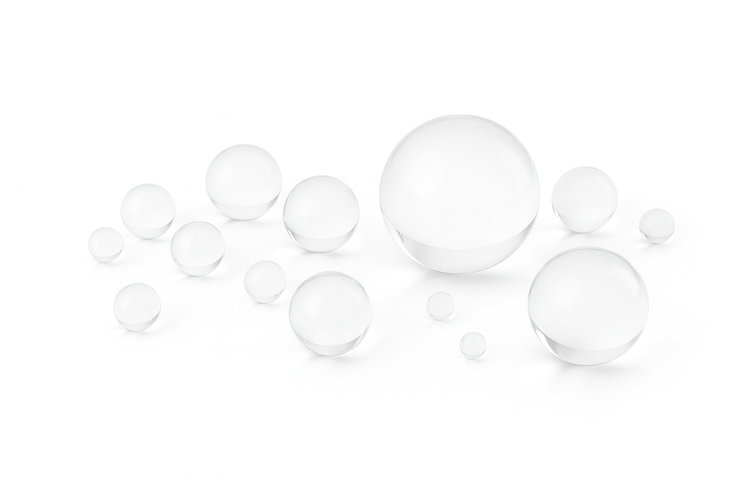
Borosilicate Glass Balls for Valves and Metering Pumps
REDHILL supplies borosilicate glass balls for check valves, dosing systems, flow indicators and lab equipment. The glass combines low thermal expansion with good chemical resistance. In addition, smooth surfaces support sealing against suitable valve seats.
Key Technical Specifications
The following values describe typical borosilicate 3.3 glass.
- Composition: Mainly silica (SiO₂) and boron oxide (B₂O₃), with alkali and aluminum oxides.
- Structure: Amorphous glass.
- Density: Approximately 2.23 g/cm³ at 25°C.
- Thermal Expansion: Approximately 3.3 × 10⁻⁶ K⁻¹ over 20–300°C.
- Electrical and Magnetic Properties: Electrical insulator and non-magnetic material.
Thermal and Chemical Resistance
Low expansion helps reduce stress during heating and cooling. Therefore, borosilicate glass generally handles temperature changes better than soda-lime glass. However, safe operating limits depend on the glass grade, ball size and thermal cycle.
The glass resists water, many acids and common solvents. However, some chemicals can attack the surface. Therefore, check compatibility with your process fluid and cleaning agents at the intended temperature.
Applications of Borosilicate Glass Balls
For example, common uses include:
- Check Valves and Dosing Systems: Balls for metering pumps and liquid dispensers.
- Flow Indicators: Clear balls for visual flow monitoring.
- Laboratory Equipment: Components for analytical and measuring devices.
- Pumps and Sprayers: Balls for suitable fluid control assemblies.
Available Grades and Sizes
- Precision Grades: G100–G1000.
- Diameters: 1.0–150.0 mm.
Available combinations depend on ball size, grade and finish. In addition, specify any optical or surface requirements.
Finally, send us your diameter, grade, quantity, fluid and operating temperature. We can then confirm suitable options and lead time.