


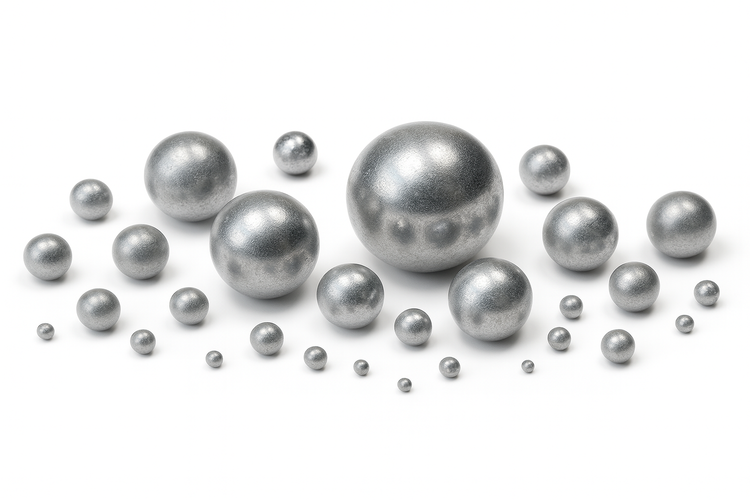
Aluminum Balls in 2017-T4 and 1100-H16
REDHILL supplies aluminum balls for lightweight mechanisms, valves and stud welding. Both grades weigh much less than steel. However, 2017-T4 offers higher strength, while 1100-H16 provides better conductivity and corrosion resistance.
Aluminum Balls 2017-T4
Alloy 2017 contains copper to increase strength. As a result, it suits mechanical parts that need strength with low weight. In addition, it offers good machinability.
Solution heat treatment and natural aging give this alloy its T4 temper. However, its corrosion resistance is lower than that of 1100. Therefore, fluid contact and any need for surface protection matter when choosing this grade.
Key Material Data
- Main alloying elements: Copper 3.5–4.5%, magnesium 0.4–0.8%, manganese 0.4–1.0% and silicon 0.2–0.8% by weight.
- Temper: T4, from solution heat treatment and natural aging.
- Density: Approximately 2.8 g/cm³.
- Magnetic properties: Non-magnetic.
Aluminum Balls 1100-H16
Alloy 1100 contains at least 99.0% aluminum. It offers good corrosion resistance, weldability and ease of forming. For example, manufacturers use 1100-H16 balls in stud welding for fastening work.
Cold working increases its strength to the H16, or three-quarter-hard, condition. In addition, 1100 conducts heat and electricity better than 2017-T4. Therefore, it suits parts where low weight, conductivity or weldability guide the choice.
Key Material Data
- Composition: At least 99.0% aluminum.
- Temper: H16, from strain hardening to the three-quarter-hard condition.
- Density: Approximately 2.71 g/cm³.
- Magnetic properties: Non-magnetic.
Applications of Aluminum Balls
- Stud welding: For example, 1100-H16 balls serve in fastening work for automotive, construction and industrial products.
- Lightweight mechanisms: By comparison, 2017-T4 offers greater strength for small moving parts in automotive and aircraft equipment.
- Valves and dispensers: Aluminum check balls suit selected fluids and sealing loads. However, the alloy must match the fluid and working conditions.
- Flow indicators and instruments: Low mass helps moving parts respond to changes in flow.
Grades and Sizes
See our precision grade guide for ball tolerances. In addition, ask us about metric, inch and custom diameters. We confirm the available grade, size and surface finish for each order.
Finally, send us your ball diameter, quantity, alloy and working conditions. We can then help you choose between 2017-T4 and 1100-H16.